
Hendricks County Civil Docket Searches
Begin at Indiana MyCase. You can search by case number, party or business name, attorney, or cross-reference. Then narrow to Hendricks County. Filters for court, status, filed date, and date of birth tame common names. Before opening a result, compare case type, court, filed date, status, and parties. Sounds-like matching helps, though it is no substitute for checking.
MyCase costs nothing, but it is not the official record. When a public document is not online, call the Hendricks County Clerk. The number is 317-745-9231. Go to 51 W. Main Street, Room 104, Danville. Ask before mailing or faxing a request. Staff can confirm the description, copy cost, and how to pay.
- Choose the Case or Name search tab.
- Set Hendricks County and add exact known details.
- Confirm the civil case type and assigned court.
- Read the CCS from filing through the latest order.
- Ask the clerk for an official or certified copy.
Hendricks Civil Assignment Rules
Under the Hendricks local rules, case type drives civil assignment. Plenary matters sit in Superior Courts 1 or 4. Tort cases belong to Circuit or Superior 1. Collections rotate among Circuit and Superior Courts 1, 4, and 5. Foreclosures land in Superior 2. That court also carries much of the probate, estate, and guardianship work. Domestic matters split between Circuit and the listed Superior Courts.
Evictions and small claims get random assignment under quota rules across specified courts. Those quotas manage capacity. They are not filing totals, and they say nothing about county caseload. That is why two similar cases can sit in different courts. Trust the current case header over any guess.
Assignment shapes every step of a docket search. A broad Hendricks County name search may pull cases from several divisions. Open the wrong one. The parties, dates, and claims may differ even when the names look alike. Check the uniform case number: two-digit county code, court identifier, case-type code, and sequence. Related-case and cross-reference fields can flag a matter that moved or was linked. When you request a document, name the exact assigned court. Do not ask for a generic civil file.
Civil Dockets: What They Show
A civil Case Summary lists the case number, court, type, status, and filed date. It also lists parties, attorneys, flags, and related cases. The Chronological Case Summary then tracks service, responses, motions, petitions, hearings, cancellations, public document links, orders, judgments, awards, and transactions. An entry proves a filing or action was recorded. It does not promise the underlying image is open online.
| Case number | Indiana uniform identifier, such as 32D01-2601-PL-000123, with county, court, period, type, and sequence. |
|---|---|
| Parties | Plaintiff and defendant, or petitioner and respondent, plus counsel. |
| Filings | Complaints, answers, motions, petitions, service returns, and orders. |
| Settings | Conferences, motion hearings, trials, cancellations, and resets. |
| Judgment | Status, award fields, amount, comments, and references when recorded. |
Hendricks Judgment Fields Need Context
A judgment block may carry status and awarded-to and against fields. Other fields cover an amount, comments, or book references. None of that settles whether the judgment was satisfied, stayed, appealed, corrected, or still owed. Read the later docket entries and the signed order itself. MyCase financial data carries a date. It is not a live clerk ledger.
Post-judgment entries can show collection proceedings, garnishment activity, a writ, an address change, or satisfaction of judgment. The Hendricks Self Service Center publishes separate materials for several of those steps. Seeing one helps explain a later docket label. It does not prove the form fits your case. Compare the filed item with the signed order and the CCS that follows. For a historical outcome, request the judgment plus any later satisfaction or release. Do not trust the first award line. That gives the clerk a defined document set and keeps an old amount from passing as current.
For a current answer: give the clerk the case number and judgment date, then request the order, satisfaction entry, or current balance that fits the question.
What Cases Fill the Civil Docket
Hendricks civil dockets hold plenary claims, torts, collections, foreclosures, evictions, small claims, estates, probate, guardianships, and some domestic matters. Small claims, eviction, and collection cases share practical issues yet remain separate dockets. Expect tighter access limits on protection orders, juvenile cases, and many family or guardianship matters.
- Plenary and tort claims with motions, settings, and judgments
- Collections and foreclosures with service and order histories
- Small claims and eviction cases under local assignment quotas
- Probate, estate, and guardianship matters, subject to access rules
- Domestic cases, some of which have limited remote access
Hendricks Small Claims Form Map
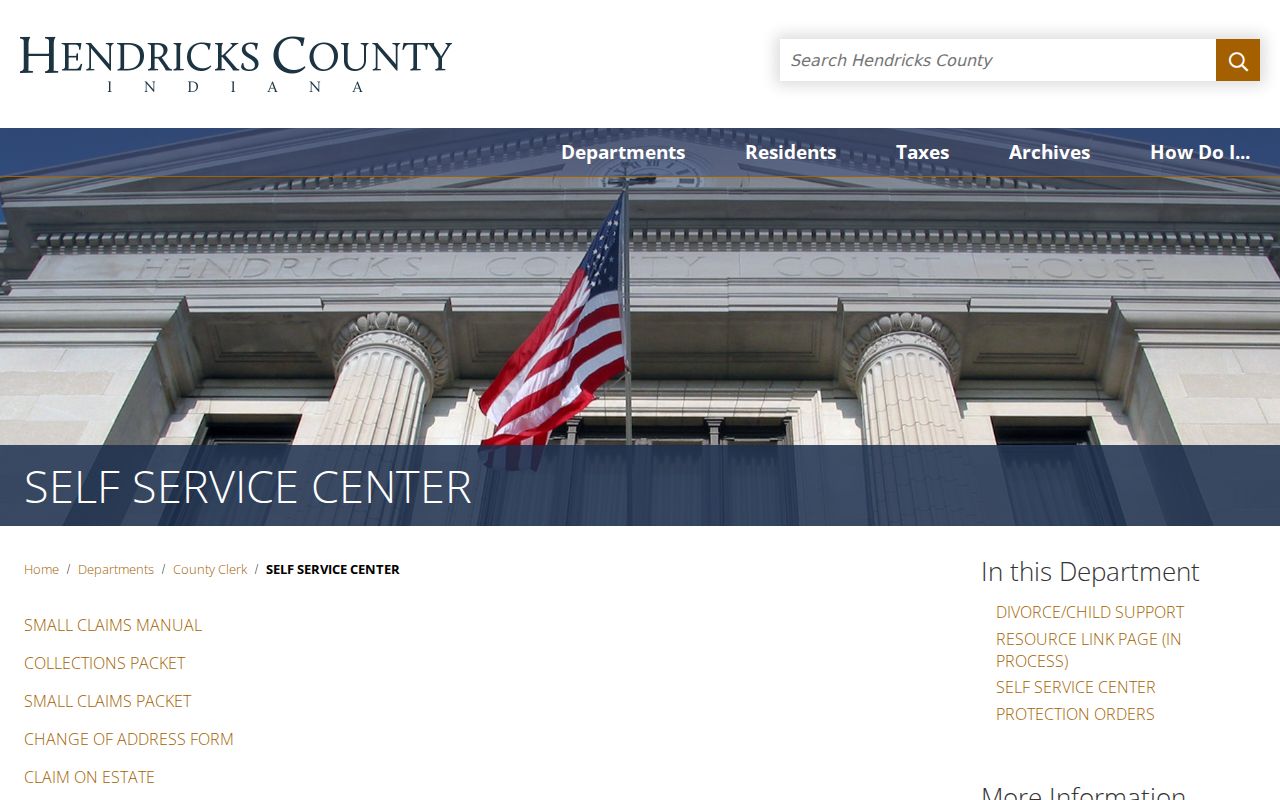
The Hendricks Self Service Center posts a Small Claims Packet and manual. Its Notice of Claim asks for party contact data. Court and service details follow, plus the service method you choose. The sheriff return records personal service. It also notes a copy left or mailed, a bad address, and other outcomes. The packet also walks through responses and counterclaims. Exhibits, copies, and the ten-day jury request get covered too.
That Self Service Center page shows the county's current filing materials.
The packet explains docket events. It is not a search portal. Its forms state no current total fee. Indiana's fee manual lists a common $35 filing fee. It adds $10 service per named defendant, with totals of $97 or $87 for e-file under stated assumptions. Service count and case facts can move the figure. Ask the clerk for a current calculation before you pay.
Hearings on the Civil Docket
Civil settings come in many shapes. A Hendricks County civil docket can list a status conference, motion hearing, pretrial conference, bench trial, jury trial, or eviction hearing, with each line giving a date, time, location, judicial officer, and type. A scheduling order may also set deadlines the hearing line never shows. Check later CCS entries. A continuance, cancellation, or replacement shows up there. Indiana Trial Court Calendars covers only participating courts. A missing result does not mean the hearing vanished, so confirm a near-term date in the current CCS and with the assigned court. The Hendricks County court schedule page walks through every calendar field.
Hendricks Missing Document Links
A docket event can be public even when its filing image is not online. MyCase sometimes shows no link. Reasons vary. The case type may allow in-person access only, the item may be confidential, imaging may be incomplete, or the court may simply not have posted it yet. The official case-type access table is the most practical map. It shows what you can reach remotely.
Make a narrow request. Give the court, case number, event date, and document title. Add the format you need. Say whether you want inspection, a plain copy, or certification. Transcripts travel a separate route. A hearing recording does too. Even public material may need redaction before release.
Access also varies within the civil docket itself: collections, tort, foreclosure, plenary, tax-deed, and tax-sale files often allow remote copies of nonconfidential orders, while small-claims files may post orders online yet keep other documents at the courthouse. Domestic, guardianship, juvenile, and protection-order material tends to be more restricted. A missing image never proves a filing did not happen. Read the CCS event, check the case-type access rule, and request only the public document you need; that keeps the public event index distinct from the underlying case file.
Who Can See Civil Dockets
Indiana Access Rule 4 starts from open access. Rule 5 then carves out confidential cases and documents. Adoption, juvenile, many domestic and guardianship matters, protection orders, sealed cases, and pre-July 2014 paternity cases may be missing or limited in a Hendricks County docket search. And Indiana Code chapter 5-14-3 does not override a court rule or a sealing order.
Access paths:
Use MyCase for public remote access, the Hendricks clerk for public records not shown online, and Access Rule 9 for a verified request seeking an excluded record.
An eligible party may request enhanced party access after identity verification. The code lasts 21 days and case access lasts 180 days.
Hendricks Civil Copy Requests
Precision speeds things up. Name the Hendricks court, the full case number, the event date, and the exact document. State the purpose. Inspection, an ordinary copy, and a certified copy each mean a different request. If the title is unclear, offer a date range and a phone number or email for questions. Ask about redaction, estimated cost, payment, and timing. Send no funds early. The clerk cannot explain an entry's legal effect. Staff can identify the record the office keeps. They can also route transcript questions to the assigned court reporter. Keep a copy of your request. Note when it was delivered. Response time depends on scope, review, redaction, and the form requested. Mail and fax work only after the Hendricks clerk confirms the current process, and no universal certified-copy web form should be assumed. Confidential files, sealed documents, in-camera items, and protected exhibits stay restricted. Courthouse inspection is open to the public during regular hours. A hearing recording follows a separate supervised-copy route under Indiana guidance and may require review or redaction.